For many patients, mobility is the key to independence. But when a manual wheelchair isn’t enough, and a power wheelchair seems like a daunting leap, where do you start? As a physical therapist, you play a critical role in determining if a power wheelchair is the right fit for your patient. It’s not just about picking a device; it’s about unlocking potential. A thorough power mobility assessment can be the difference between a patient observing life from the sidelines and actively participating in it.
This guide will walk you through the essentials of power mobility assessment, from analyzing medical impacts to selecting the perfect driving method. Whether you’re a seasoned pro or just starting your journey in complex rehab technology, understanding these fundamentals will empower you to make recommendations that truly change lives.
The power mobility assessment process
The primary goal of a power mobility assessment is simple: determine appropriateness and make the optimal recommendation. But getting there requires a team approach. If you aren’t experienced in mobility assessment, don’t hesitate to refer your patient to a specialized seating and mobility clinic.
A comprehensive assessment looks at the whole person. You aren’t just checking boxes; you’re evaluating current mobility skills, home accessibility, cognitive abilities, and future needs.
Related CE course for PTs: Power Mobility Assessment and Driving Methods

Key goals for the clinician
- Determine appropriateness: Is a power wheelchair actually the best solution? Sometimes a patient needs to develop readiness skills first.
- Select optimal equipment: This includes the drive wheel configuration, power seating functions, and tracking technologies.
- Justify the need: Articulate why lower-category equipment won’t meet the patient’s needs in order to secure funding.
- Plan for training: A device is only useful if the patient and caregivers know how to use it safely.
Analyzing medical issues
A patient’s medical condition significantly impacts their ability to operate a power wheelchair. When assessing a client, consider how their diagnosis affects their motor control and overall function.
Motor control and muscle tone
Power wheelchairs require volitional, isolated, and controlled movements.
- Low tone: Clients with low muscle tone may have limited active range of motion and decreased strength. They might struggle to sustain the force needed for a standard joystick.
- Increased tone: High tone often limits control at midline. It can also result in reflexive movements that interfere with driving.
- Fluctuating tone: If tone changes throughout the day, performance will fluctuate. You need a driving method that works even on their “bad” days.
Vision and perception
Don’t rule out power mobility solely based on vision. Many clients with low vision or visual perceptual deficits drive successfully, especially in familiar indoor environments.
Cognitive issues
Cognition is a factor, but it shouldn’t be a barrier to trying. Does the client understand cause and effect? Do they have basic stop-and-go concepts? Remember, mobility itself can promote cognitive development. As RESNA recommends, early utilization of power mobility is crucial for children to promote psychosocial development and reduce passive dependency.
Choosing the right drive wheel configuration
The drive wheel configuration—where the large drive wheels are located on the base—affects how the chair maneuvers. There are three main types, each with pros and cons.
Rear wheel drive (RWD)
- Pros: RWD offers great stability, especially outdoors and at higher speeds. It generally has the best suspension.
- Cons: It has the largest turning radius, making tight indoor spaces tricky.
Front wheel drive (FWD)
- Pros: FWD chairs are excellent at climbing obstacles because the large wheels pull the weight over bumps. They also allow for tight turns.
- Cons: They can be less stable at high speeds (potentially “fishtailing”) and may feel tippy forward if a client stands on the footplates.
Mid wheel drive (MWD)
- Pros: MWD offers the smallest turning radius and footprint. It is often considered the most intuitive because the chair turns on the driver’s own center axis.
- Cons: It may struggle more on aggressive outdoor terrain compared to RWD.
Which is best? For clients using alternative driving methods (like switches), MWD is often the most efficient choice because it requires fewer compensatory movements to stay on track.
Proportional vs. non-proportional driving methods
Once you’ve selected the base, you must decide how the client will drive it.
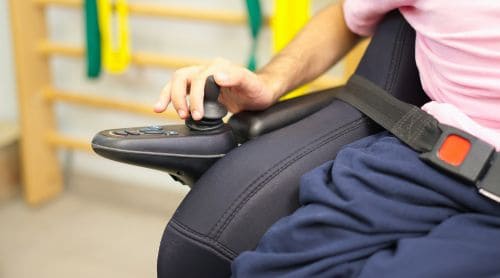
Proportional control (joysticks)
Proportional control means the chair moves in the direction you push the joystick, and the speed depends on how far you push it. It requires grading of force and distance.
- Standard joysticks: The go-to for clients with good hand function.
- Compact joysticks: useful if mounting space is limited.
- Mini proportional joysticks: These require very little force (10–50 grams vs. 250 grams for a standard joystick). They are perfect for clients with muscle weakness, such as those with SMA or muscular dystrophy. They can be mounted at the chin, finger, or lip.
Non-proportional control (digital)
If a client cannot grade force and distance, they need a digital system. These are “all or nothing” switches—the chair is either moving or it isn’t.
Common digital options:
- Mechanical switches: Good for clients with fair upper extremity control but poor fine motor skills.
- Proximity switches: These activate when a body part gets near them (no touch required). They are great for clients who can’t exert force.
- Head arrays: A system of proximity switches inside a headrest. The client drives by moving their head left, right, or back.
- Sip ‘n puff: For clients with high-level spinal cord injuries who have good oral motor control. Hard puffs/sips and soft puffs/sips control direction and speed.
Case study: Putting it into practice
Let’s look at Miles, a 3-year-old with cerebral palsy and very low muscle tone.
The challenge: Miles sat in a custom mold on a manual wheelchair. He had very good cognitive skills but lacked the motor control to use a standard joystick.
The assessment:
- Readiness: The team used his manual chair to test switch sites. They found he could control switches on either side of his head.
- Trial: In a power chair evaluation, they placed switches at his head for left/right turns. For forward movement, they found he could rest his hand on a tray-mounted switch and press down to go.
- Result: Miles received a power wheelchair with a head support for turning and a tray switch for forward movement. This setup allowed him to explore his world independently for the first time.
Moving forward
Power mobility assessment is a journey, not a single appointment. It requires patience, creativity, and a willingness to try different configurations. But the reward—seeing a client move independently—is worth every step.
If you’re ready to deepen your knowledge, consider taking a specialized course or connecting with a mentor in the field. Your expertise could be the key to someone’s freedom.