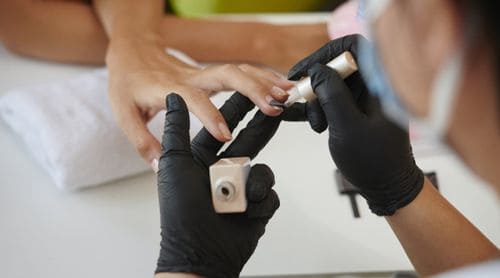
If you have a creative flair and enjoy helping others feel their best, a career in the beauty industry might be your perfect match. Specifically, becoming a licensed nail technician offers a unique blend of artistic expression and technical skill. It’s a career path that allows you to work directly with clients, helping them express their own style through manicures, pedicures, and nail art.
This guide explores what you can expect from this profession and the concrete steps you need to take to earn your license.

What does a nail technician do?
A nail technician does much more than just apply polish. They’re trained professionals who care for the health and appearance of fingernails and toenails. When you become a licensed nail technician, you provide a wide range of services that go beyond basic aesthetics.
Standard treatments include manicures and pedicures, where you clean, shape, and trim nails. You also care for the cuticles and often provide hand and foot massages to improve circulation and relaxation. Beyond the basics, technicians apply artificial nails, gel coverings, and acrylics.
Nail art is another huge component of the job today. Clients often request intricate designs, gems, or specific trends they see on social media. Additionally, you are responsible for maintaining a sanitary workspace. Sterilizing tools and keeping your station clean is critical for client safety and health.
Steps to become a licensed nail technician
While the process varies slightly by state, the general path to licensure follows a similar structure.
1. Complete a cosmetology or nail technician program
You must attend a state-approved cosmetology or nail technician school. These programs cover essential topics like anatomy, physiology, sanitation, and chemistry. Here, you’ll learn about nail diseases and disorders to ensure you can identify when a client needs medical attention rather than a cosmetic treatment.
2. Finish practical training hours
Schooling isn’t just about textbooks. You need hands-on experience. Most states require a specific number of training hours—often between 300 and 600 hours—before you can take your licensing exam. During this time, you practice techniques on mannequins and eventually on real clients under supervision.
3. Pass the state board exam
Once your education hours are complete, you must pass a state board exam. This typically includes a written portion testing your theoretical knowledge and a practical portion where you demonstrate your skills in front of an evaluator.
4. Apply for your license
After passing the exam, you submit an application and a fee to your state’s cosmetology board to receive your official license.
Continuing education requirements
Getting your license is a huge achievement, but your education doesn’t stop there. The beauty industry evolves rapidly. New products, safety standards, and trends emerge constantly.
Most states require you to renew your license every two years. To do this, you often need to complete continuing education (CE) credits. These courses ensure you stay up-to-date on sanitation laws and industry best practices. Even if your state doesn’t strictly mandate CE for renewal, taking advanced courses in nail art or new application techniques can help you attract more clients and grow your income.
Explore CE courses for salon professionals
Is this career right for you?
Successful nail technicians share a few key traits. Creativity is high on the list, as clients will look to you for design ideas. Patience and attention to detail are also crucial; working with small canvases requires a steady hand.
Social skills are equally important. You spend a lot of time one-on-one with clients, so being a good listener and conversationalist helps build a loyal customer base. If you love variety, flexibility, and making people feel confident, this could be the ideal career move for you.