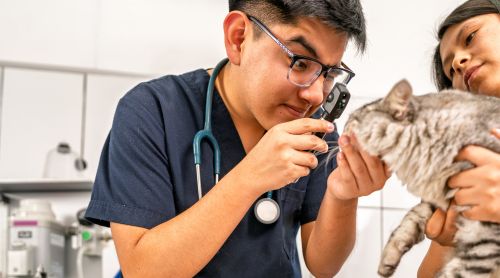
When people think about careers in veterinary care, the image that usually comes to mind is a single veterinarian treating a sick dog or cat. In reality, the field is far broader than that. Opportunities span multiple credential levels, wildly different work settings, and career paths that go well beyond the small-animal clinic most people picture.

Veterinarians (DVM)
Doctors of Veterinary Medicine complete a four-year veterinary degree following undergraduate coursework, then sit for licensing exams before practicing independently. Within this credential alone, career paths diverge significantly. Small-animal general practice remains the most common route, but veterinarians also specialize in large-animal or equine medicine, exotic and zoo animal care, and increasingly, board-certified specialties like veterinary cardiology, oncology, or dermatology, which require additional years of residency training beyond the base DVM.
Veterinarians can also move into research, public health (working with agencies like the USDA or CDC on zoonotic disease surveillance), pharmaceutical and animal health industry roles, or academic teaching positions at veterinary schools.
Veterinary technicians and technologists
Veterinary technicians play a role in animal care roughly analogous to nurses in human medicine. They handle anesthesia monitoring, diagnostic testing, surgical assistance, and client education. Technicians typically complete a two-year associate degree program, while veterinary technologists complete a four-year bachelor’s degree, both followed by a credentialing exam depending on state requirements.
This role has grown increasingly specialized, with technicians able to pursue certification in areas like emergency and critical care, anesthesia, dentistry, or behavior, expanding both their clinical scope and earning potential within the field.
Veterinary assistants
Veterinary assistants provide hands-on support under the supervision of veterinarians and technicians. Often, they handle tasks like animal restraint, basic care, kennel management, and administrative support. This role often serves as an entry point into the field, with many assistants going on to pursue technician credentials or veterinary school once they’ve gained direct clinical experience.
Specialized and alternative practice settings
Beyond the traditional clinic, veterinary professionals work in a genuinely wide range of settings. Shelter medicine focuses on the unique challenges of animal welfare organizations, including high-volume spay and neuter programs and population health management.
Zoo and wildlife veterinary medicine involves an entirely different scope of species knowledge and often intersects with conservation work. Food animal and production medicine supports the health of livestock at scale, with a direct connection to food safety and public health.
Mobile and house-call veterinary practices have also grown significantly, offering an alternative to the traditional brick-and-mortar clinic model and appealing to veterinarians who want more flexibility or a different pace of practice.
Research and industry paths
Not every veterinary career centers on direct patient care. Veterinarians and credentialed technicians work in pharmaceutical research, animal nutrition companies, biotech firms developing new treatments, and regulatory agencies overseeing drug approval and food safety standards. These roles often appeal to those drawn to the scientific side of the field who want to apply their clinical training to broader population-level impact.
The realities worth knowing upfront
Veterinary medicine carries real challenges worth understanding honestly. Compassion fatigue and burnout rates run notably high across the profession, driven by factors including emotionally difficult cases, client financial constraints affecting treatment decisions, and in many cases, substantial student debt relative to average starting salaries for general practice roles.
These realities don’t diminish the appeal of the work for those genuinely drawn to it, but they’re worth factoring into career planning rather than discovering only after entering the field.
Education and credentialing paths at a glance
Each veterinary career path comes with its own educational timeline and credentialing process.
- Veterinary assistants can often begin working with on-the-job training or a short certificate program, making it one of the more accessible entry points into the field.
- Veterinary technicians typically need an accredited associate degree and a credentialing exam. Usually, this process takes two to three years, including clinical hour requirements.
- Veterinarians face the longest path: four years of veterinary school after a bachelor’s degree, followed by licensing exams and, for those pursuing board certification, several additional years of residency training in their chosen specialty.
Understanding this range matters for anyone exploring the field. It means there’s a viable entry point regardless of how much time and financial investment a person is ready to commit upfront. Many veterinary technicians and assistants also use their early clinical experience to decide whether pursuing veterinary school later makes sense for them, rather than committing to that lengthy path from the very start.
A field with genuine breadth
Whether the draw is hands-on clinical work, scientific research, public health, or something in between, veterinary care offers career paths for a wide range of interests and skill sets, not just the general small-animal practice most people first picture.
Building specialized knowledge matters at every stage of a veterinary career. Explore continuing education courses for veterinary professionals covering the clinical skills and practice areas shaping the field today.