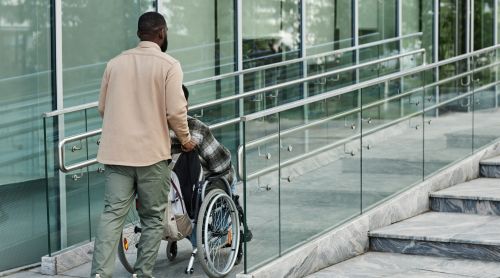
Making healthcare accessible usually gets discussed in terms of ramps, elevators, and door widths. Those things matter, but nurse and disability advocate Andrea Dalzell argues that true accessibility goes further: it’s about dignity. On the latest Elite Learning podcast episode, she explains why treating accessibility as a checkbox exercise leaves both patients and nurses at risk. Listen to the episode here.

Why checklists aren’t enough
A checklist can confirm a ramp exists. It can’t confirm that a patient feels able to participate in their own care without asking permission first. Dalzell describes accessibility as something that should let people show up and take part with their own dignity intact, not as a favor granted after the fact.
When healthcare accessibility stops at the physical layer, it misses the emotional and procedural barriers patients face every day. This can range from unclear communication to rushed appointments that don’t account for mobility or sensory needs.
A barrier hiding in plain sight
Dalzell points to her own path through nursing school as an example. Organic chemistry, a required course, was taught in labs without accessible fume hoods, twice, years apart, at two different points in her education. No one had thought to plan for a student who used a wheelchair. That’s the kind of gap a compliance checklist won’t catch, because it only shows up when someone tries to use the space and can’t.
What this means for nurses
Nurses sit closest to these gaps. They’re the ones who notice when a blood pressure cuff doesn’t fit, when a bed can’t lower far enough, or when a patient can’t reach the call button. A few starting points for pushing healthcare accessibility forward:
- Flag physical or procedural barriers as they come up, not just during formal audits
- Ask patients what they need instead of assuming a standard setup works
- Support disability-focused organizations in the community, even informally
- Advocate for accommodations that protect nurses too, since musculoskeletal injuries remain common on the job
Where to hear more
Dalzell’s own experience navigating nursing school and bedside care as a wheelchair user gives this conversation weight that a policy document can’t match. Her insights apply to any nurse working to make care more accessible in practice, not just on paper. Catch the full episode on the Elite Learning podcast.